June 2, 2026 · Texera Team
How to Start a Clothing Brand: A Step-by-Step Guide for Small Budgets
Starting a clothing brand doesn't need the capital most people assume. With a clear niche, one well-made product and a manufacturer that accepts a 100-piece minimum order, you can launch a real, sellable first collection without tying up cash in stock you can't move.
This guide walks through the whole path, from idea to your first reorder, from the side of the table most guides skip: the factory floor. It covers what each step costs, where first-time founders lose money, and what to ask a manufacturer before you pay a deposit.
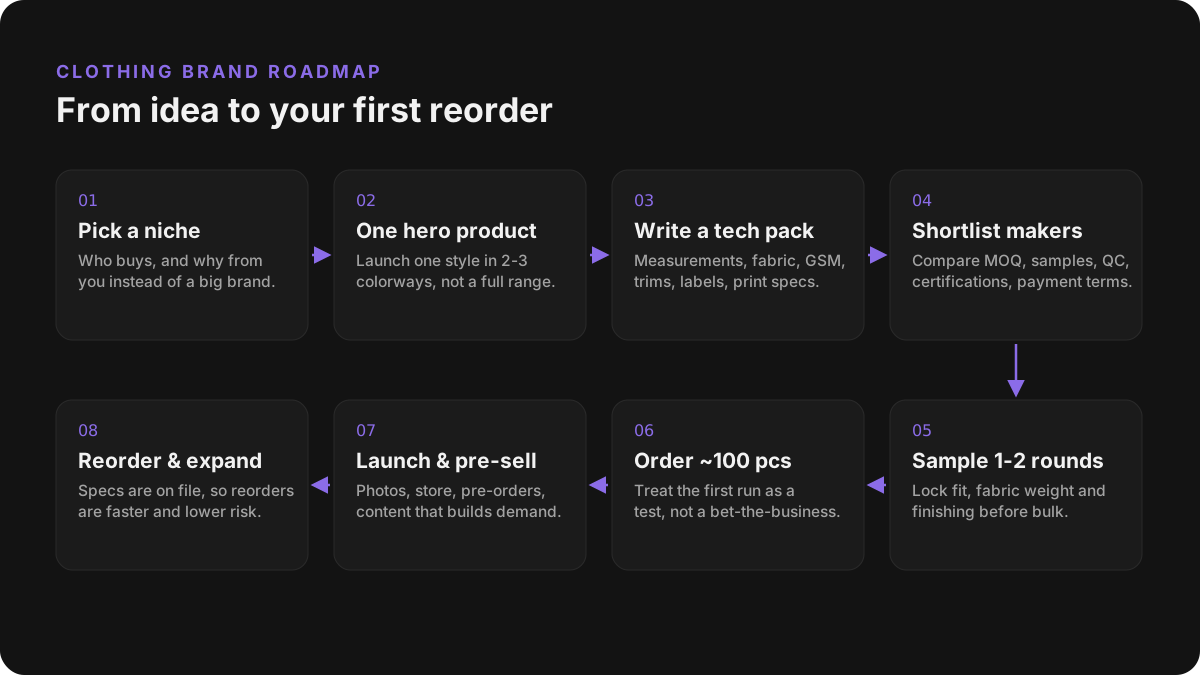
Step 1: Pick a niche you can actually win
"Streetwear" is not a niche; "heavyweight boxy tees for skaters who run hot" is. A niche tells you three things you need before you spend anything: who the customer is, what they already buy, and why they would buy from you instead of a brand with a bigger marketing budget.
A quick test: can you name five places your customer spends time online, and three brands they already wear? If you can't, keep narrowing.
Step 2: Launch one hero product, not a collection
The most common way a small budget disappears is by spreading it across too many styles. Every extra style adds its own samples, its own pattern and its own minimum order.
Start with one style in two or three colorways. A hoodie or a heavyweight tee is a popular first product because the fit is forgiving and the perceived value is high. You learn more from selling out of one great product than from half-selling eight average ones.
Step 3: Write a tech pack (even a simple one)
A tech pack is the document a factory builds your garment from. It's the single best protection against a sample that "looks nothing like what I asked for." At minimum it should include:
- Flat sketches, front and back, with every seam and detail marked
- A measurement chart for each size (the "graded spec")
- Fabric: composition, construction (jersey, fleece, twill) and weight in GSM. If GSM is new to you, read what GSM in fabric means.
- Trims: thread color, labels, drawcords, zips, eyelets
- Decoration: print or embroidery placement, size and colors
- Packaging: folding, polybags, hangtags
You don't need expensive software. A clear PDF with labeled sketches and a size table is enough for a good manufacturer to quote and sample from.
Step 4: Shortlist manufacturers and ask the right questions
Look for a manufacturer whose minimum order matches your stage and who handles the stages you can't. A full-package manufacturer sources fabric, cuts, sews and finishes; a cut-make-trim (CMT) factory expects you to supply the fabric. For a first-time founder, full package is almost always simpler. For a deeper walkthrough, see our guide on how to choose a garment manufacturer.
Questions to ask before you pay anything:
- What is your minimum order per style, and per color?
- How much do samples cost, how long do they take, and how many revision rounds are included?
- Do you make the fabric in-house, or source it? Can I get a swatch at my target GSM?
- How is bulk production checked against my approved sample?
- What are your payment terms (deposit, balance, when each is due)?
- Which certifications do you hold (for example OEKO-TEX, GOTS or Sedex), and can you share the certificates?
Vague answers to questions 2, 4 and 5 are the clearest warning sign at this stage.
Step 5: Budget for one or two sample rounds
Sampling is where fit, fabric weight and finishing get locked in. Expect one to two rounds before production. It is not the step to skip to save money: skipping it is the most common reason a first production run disappoints.
Ask for a pre-production sample made in the actual bulk fabric before you approve the run, and approve it in writing. That sample becomes the standard every finished unit is checked against.
Step 6: Order around 100 pieces for your first run
Treat your first run as a test, not a bet-the-business moment. One hundred pieces is enough to fill a launch, collect real customer feedback and learn which sizes sell.
What a first run actually costs
Here is what 100 midweight T-shirts with a one-color screen print come to in our cost calculator, which uses the same formula we quote from:
| Cost line | Per unit |
|---|---|
| Fabric (0.18 kg at midweight) | $1.44 |
| Cut & sew labor | $1.80 |
| Trims & labels | $0.15 |
| One-color screen print (incl. setup) | $0.95 |
| Basic polybag | $0.12 |
| Estimated range | $4.01–$5.13 |
That's roughly $400–$515 for the production run itself. Your total launch budget also needs to cover samples, shipping, import duties where they apply, product photography and your store. For a heavier product, see the per-unit breakdown in our hoodie manufacturer guide.
Size split for a first run
Don't split sizes evenly. For a unisex fit, a typical starting curve weights the middle sizes (for example, more M and L than XS or 3XL). Your own pre-orders or audience data beat any rule of thumb, so use them if you have them.
Labels you'll need
If you sell in the United States, garments generally need labels showing fiber content, country of origin, the identity of the manufacturer or dealer (often an RN number), and care instructions. Ask your manufacturer to include these in the tech pack so they're sewn in during production, not added afterwards.
Step 7: Launch, and pre-sell if you can
Pre-orders are the closest thing to free working capital a new brand has. Show the approved sample, open pre-orders for a set window, and use the result to confirm your size split before bulk production starts.
Invest in good photos of the real product. The approved sample is enough for a first shoot.
Step 8: Reorder before you scale
A fast reorder cycle matters more early on than a big first order. Patterns and specs are already on file by the time you reorder, so the second run is typically faster, lower risk and can stay small. Add a second style only once the first one sells through.
Watch: producing a clothing line, step by step
This walkthrough from the Make Good Fashion channel covers the production side, from design to finished product, and pairs well with steps 3 to 6 above.
Frequently asked questions
How much does it cost to start a clothing brand?
For the production run itself, a 100-piece first run of a simple T-shirt can start around $400–$515 using the figures above. Heavier garments such as hoodies cost more per unit. On top of production, budget for samples, shipping, any import duties, photography and your online store.
Can I start a clothing brand with no experience?
Yes. Most first-time founders don't have a design or production background. What you need is a clear niche, a tech pack that describes exactly what you want, and a manufacturer that explains its process and checks bulk production against your approved sample.
What's the minimum order for a first clothing run?
It depends on the manufacturer. Many factories require several hundred pieces per style; some, including Texera, start programs from 100 units. Always ask whether the minimum applies per style or per color.
Should I use print-on-demand or a manufacturer?
Print-on-demand needs almost no upfront money but limits you to blank garments with a print, at a thin margin. A manufacturer costs more upfront but gives you your own fit, fabric, labels and a much better per-unit cost. Many brands start with print-on-demand to test designs, then move to a manufacturer once something sells.
Ready to scope your first run? Estimate your cost, or send us your tech pack and we'll come back with pricing direction.